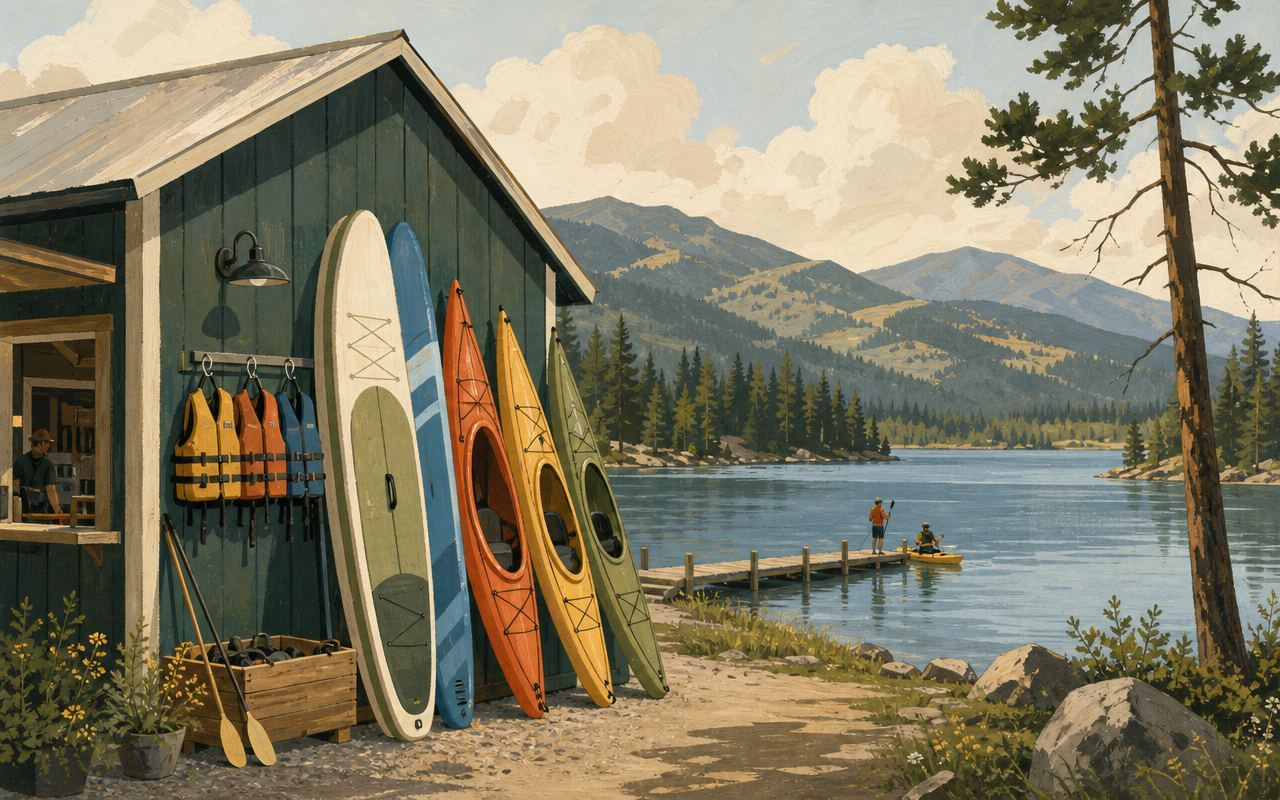
Flathead Lake draws paddlers on both sea kayaks and stand-up paddleboards, and either can make for a genuinely good day out. But the two crafts don’t behave the same way once this particular lake starts acting like itself — a big, wind-exposed body of water where a glassy morning can turn to whitecaps by early afternoon. Choosing between them here isn’t really a question of which is more fun. It’s a question of which one matches the specific stretch of water and the specific trip you’re planning.

How each handles Flathead’s wind and chop
The core difference between a sea kayak and a paddleboard on open water comes down to posture. A kayak paddler sits low, inside a hull, with most of their body shielded from wind by the boat itself. A paddleboarder stands upright, fully exposed, with almost their entire body acting as a sail the moment a headwind or crosswind builds. On a small, sheltered pond that difference barely matters. On a lake the size of Flathead, where the surrounding mountains and open basin generate a real afternoon wind pattern, it matters a great deal.
A sea kayak’s low center of gravity and hull shape also give it better tracking and stability once waves start forming — it’s built to hold a line and take chop at an angle without much drama, which is exactly the skill a paddler needs on open water. A paddleboard, by contrast, is more prone to catching wind broadside and getting pushed off course, and the higher, less stable standing position makes it easier to be knocked off balance by a gust or a boat wake than it is to be knocked off a kayak seat. None of this means a paddleboard can’t handle real conditions — some paddlers manage windy water on a SUP by dropping to a kneeling position, which lowers their profile and center of gravity — but it does mean a SUP asks more of the paddler and gives less margin once the lake’s wind pattern kicks in.
This is the same wind pattern covered in this site’s kayaking guide: mornings on Flathead Lake are frequently calm, and wind tends to build through the day, especially on the open central and southern basin. That pattern applies to both crafts, but it applies with more consequence to a paddleboard, simply because there’s more surface area catching that wind and less to keep a standing paddler steady once it arrives.
Which fits which trip
A short, sheltered paddle close to shore — hugging the coves near Somers, for instance, or exploring the shoreline near a state park unit — is a reasonable trip for either a kayak or a paddleboard. Protected water, close to a bail-out point, is where a paddleboard’s advantages (an easy-to-remount platform, a full-body workout, a clear view of the water beneath you) come without much of a wind-related downside.
An open crossing is a different story. The Big Arm to Wild Horse Island crossing, the signature open-water test covered in this site’s kayaking guide, involves roughly two miles of exposed water with no shoreline to duck into partway across. That’s a trip built for a sea kayak. A kayak’s speed, tracking, and lower wind profile all matter more the farther you get from a bail-out shore, and a kayak paddler who needs to power through an unexpected headwind on the way back has real tools — a seated position, a longer stroke, a hull built to hold a line — that a standing paddleboarder doesn’t have to the same degree.
That doesn’t mean paddleboards are wrong for Flathead Lake — plenty of paddlers enjoy them here — it means matching the craft to the specific stretch of water matters more on this lake than on a small, calm one. A rule of thumb worth borrowing from the kayaking guide’s own logic: judge a route by how exposed it is to open water, not just by how many miles it covers, and choose your craft accordingly. A short paddle inside a sheltered bay and a short open crossing are not the same trip, even when the distance looks similar on a map.
Cold-water safety considerations for each
Flathead Lake is deep and glacially influenced, and it stays cold well below the surface even in the height of summer — a fact that shapes safety planning for both crafts, in somewhat different ways.
On a paddleboard, the leash is the equivalent of the kayaker’s life jacket discipline: wear it, every time. A board blown away from a paddler who’s just fallen in cold water can move faster than a tiring swimmer can chase it, especially once wind is involved, and a paddler separated from their board on open water is in a genuinely serious position. A coiled or waist-mounted leash, rather than a straight ankle leash, is generally the better choice on open or debris-free water, since it reduces the entanglement risk that a straight ankle leash carries. Falling off a SUP is common and usually not a big event on its own — remounting a board is generally straightforward — but on cold, wind-exposed water, a fall away from the board is the scenario that matters most to plan for.
On a kayak, the equivalent consideration is the wet exit — getting clear of the cockpit after a capsize. Paddlers who haven’t practiced this, particularly in a boat with a snug-fitting spray skirt, can find it disorienting the first time it happens for real, and cold water saps grip strength and fine motor control within minutes, which makes an unpracticed wet exit harder than it would be in a pool. Practicing a wet exit in calm, shallow water before ever needing one on the open lake is genuinely worthwhile preparation, not an overcautious extra step.
Both crafts share the same non-negotiable baseline covered elsewhere on this site: wear a properly fitted life jacket the entire time, not just on board and within reach, and dress for the water temperature rather than the air temperature. Cold-water immersion doesn’t care which craft put you in the water.
Rent vs. bring your own
The rent-versus-own calculation covered in this site’s gear-rentals guide applies to both crafts, with one added wrinkle worth knowing before you book: ask specifically what you’re renting, not just “a kayak” or “a paddleboard.” Rental fleets commonly include wider, more stable recreational kayaks alongside true sea kayaks, and the recreational versions — like paddleboards — are not well suited to open-water wind and chop, even though they’re comfortable and easy to handle on sheltered water. If your plan involves anything beyond a sheltered shoreline paddle, confirm you’re getting a boat built for it.
Renting either craft is also a reasonable way to figure out which one you actually prefer before deciding whether it’s worth owning. A paddleboard packs down small if you go inflatable, which matters if storage or transport is a concern, while a sea kayak generally rewards the investment if you expect to spend real time on open water. Whichever you choose, the fundamentals — a real wind check before you launch, a life jacket worn the whole time, and a route that matches your craft’s actual strengths — matter more here than on a smaller, calmer lake.
Inflatable vs. Hardshell, for Either Craft
The rent-versus-own decision has a second layer worth thinking through once you’re past kayak-versus-paddleboard: inflatable versus hardshell construction, which applies to both crafts and matters more here than it would on a small local pond. A hardshell sea kayak or hardshell SUP holds a straighter line, responds more predictably to a paddle stroke, and generally handles chop with less flex than an inflatable version of the same craft — real advantages on a lake where an afternoon can turn from glassy to whitecapped. Inflatables have closed most of that performance gap in recent years, especially in kayaks, but a hardshell still has the edge for anyone planning real open-water distance rather than a short shoreline paddle.
What inflatables win on is everything around the paddling itself: a deflated board or kayak packs into a duffel bag that fits in a car trunk or a plane’s checked luggage, rather than needing a roof rack, a trailer, or dedicated storage space at home. For a visitor flying into Kalispell without a vehicle built for hauling a hardshell boat, or for anyone without year-round storage for a 10-to-17-foot hull, that packability is a genuine, practical reason to choose an inflatable over a hardshell — even knowing it gives up a little stability and tracking on the lake’s more exposed water. Puncture resistance on a quality inflatable is generally good enough for the cobble and gravel launches typical around Flathead Lake, though the same debris-avoidance common sense that applies to any inflatable watercraft still applies here.
For a first trip on Flathead Lake, the practical answer is usually the same one that applies to kayak-versus-paddleboard itself: match the boat to the water. A sheltered shoreline paddle near Somers or a calm cove is forgiving of an inflatable’s small performance tradeoffs. A genuine open-water route, the Big Arm to Wild Horse Island crossing chief among them, rewards a hardshell’s stability and tracking enough that it’s worth the extra hassle of transporting one.
Frequently asked questions
Is a paddleboard or a kayak better for a beginner on Flathead Lake?
For a first outing kept close to a sheltered shoreline, either can work. But if there's any chance wind picks up before you're back at the launch, a kayak's lower profile and seated stability give a beginner more margin for error than a paddleboard's standing position does. Beginners on either craft do best sticking to protected coves near town rather than open stretches of the lake.
Can you paddleboard the Big Arm to Wild Horse Island crossing?
It's been done, but a sea kayak is the better tool for that specific crossing. The open water between Big Arm and the island has no shoreline to duck into partway across, and a paddleboard's standing paddler catches far more wind than a seated kayaker, which turns a marginal headwind into a much harder slog — or a fall — well before a kayak would be in real trouble.
Why do paddleboarders fall in more often than kayakers?
Standing raises your center of gravity and shrinks your base of support compared to sitting inside a kayak's hull, so a gust, a wake, or a moment of inattention is more likely to put a SUP paddler in the water. This isn't a flaw in paddleboards — it's just the tradeoff for the standing position — but it matters more on a lake where the water stays cold year-round.
Do I need a leash if I paddleboard on Flathead Lake?
Yes. A properly rated leash keeps your board within reach after a fall, which matters enormously on open, wind-exposed water where a board blown away from you can outpace a swimmer trying to catch it. Use a coiled or waist leash rather than a straight ankle leash if you're anywhere with the potential for entanglement, such as near submerged structure.
What is a wet exit, and does it apply to paddleboarding too?
A wet exit is the process of getting out of a kayak's cockpit after a capsize, which some paddlers, especially in a boat with a snug spray skirt, haven't practiced and can find disorienting under cold water. It doesn't apply the same way to paddleboarding, since falling off a SUP simply puts you in the water without anything to exit — one reason some paddlers find a capsized SUP less alarming to recover from than a capsized kayak, even though falling happens more often on a board.
Is it easier to rent a kayak or a paddleboard around Flathead Lake?
Both are commonly available to rent, and the choice usually comes down to the trip rather than availability. Renting lets you try a boat's or board's fit and stability before deciding whether it's worth owning one, which is worth doing given how differently the two crafts behave once the wind comes up.
Is an inflatable kayak or paddleboard good enough for Flathead Lake?
For a sheltered, close-to-shore paddle, yes — modern inflatables handle calm water well and pack down for easy transport and storage. For an open-water route like the Big Arm to Wild Horse Island crossing, a hardshell's better tracking and stability in chop make it the safer, more capable choice, even though it's harder to transport and store.
Which craft is warmer and drier on a cool morning?
A kayak, generally. Sitting inside a hull, often with a spray skirt, blocks wind and spray in a way that standing fully exposed on a paddleboard doesn't. On a cold morning or a shoulder-season trip, that difference is worth factoring in alongside stability and speed.