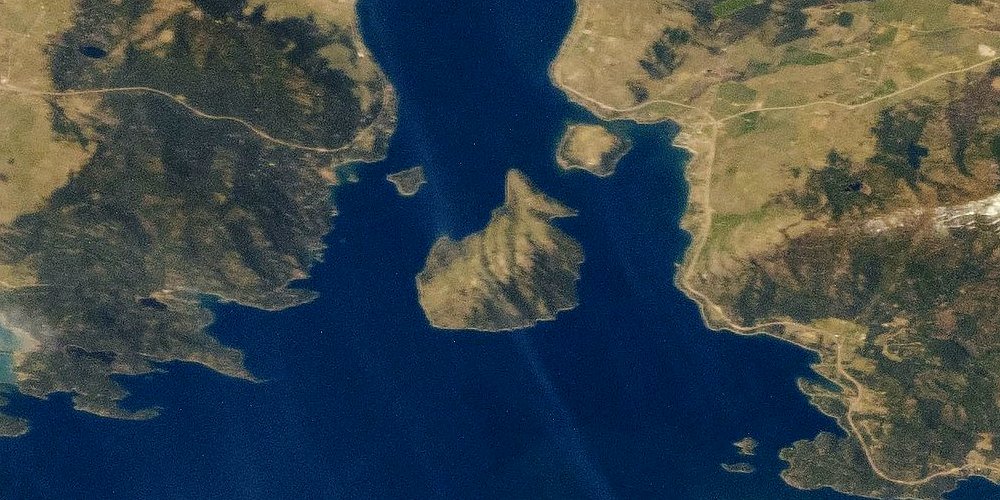
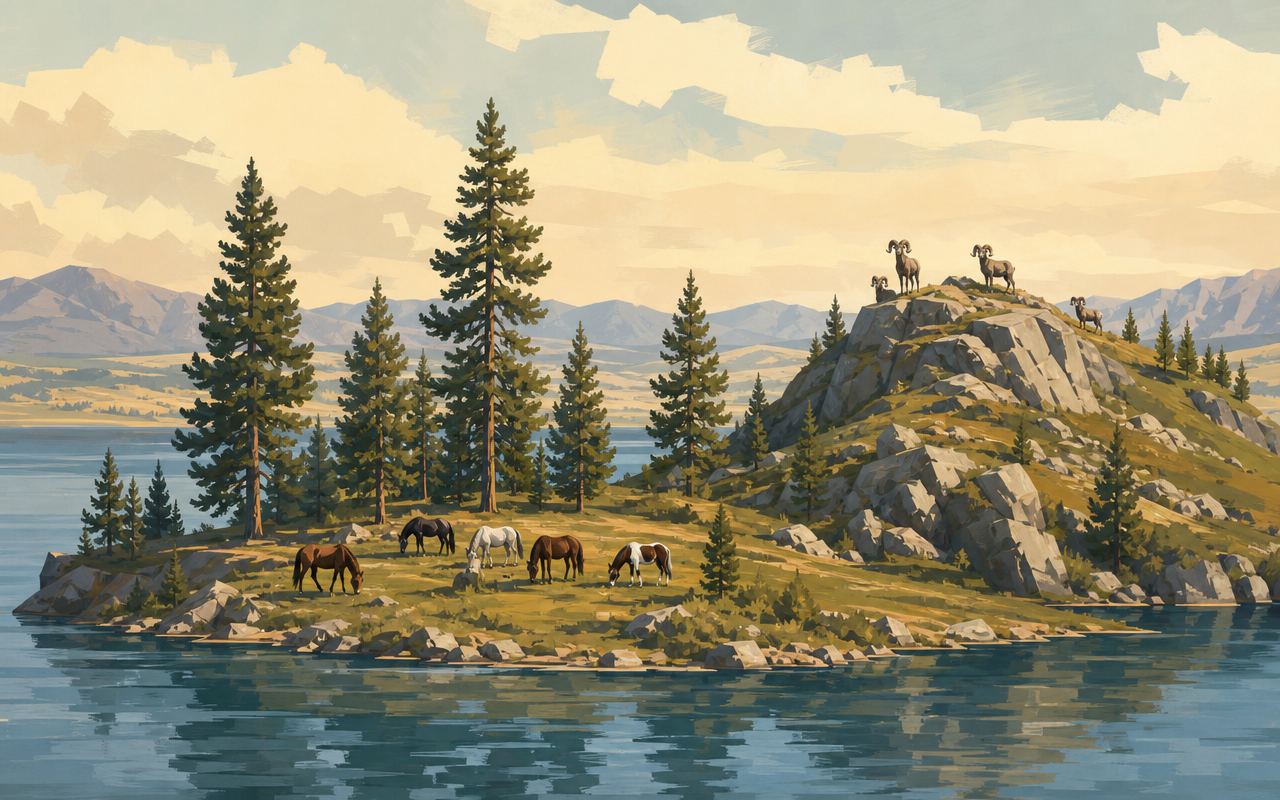
Wild Horse Island sits in the middle of Flathead Lake like a piece of the surrounding mountains that broke loose and drifted out into the water — grassy hillsides, stands of old-growth ponderosa pine, and open sightlines down to a shoreline that has no docks, no cabins, and no road in. It’s the largest island on Flathead Lake, and it’s managed as a Montana state park, but it doesn’t look or feel like a conventional park. There’s no visitor center, no paved path, no ranger station waiting at a trailhead. There’s a shoreline, a scattering of unmarked trails, and a small, protected population of animals that have had the run of the place for generations.
That combination — genuinely wild, but genuinely reachable — is what draws people across the open water to it. This guide covers what a visit actually involves: how you get there, what you’re likely to see, the rules that keep the island the way it is, the documented history behind its name, and when to go if you want the best chance of a good crossing and good wildlife viewing on the same day.
Getting there
There is no bridge, causeway, or ferry service to Wild Horse Island. The only way onto it is by boat — your own, a rental, or a guided trip arranged through one of the marinas and outfitters that operate around Flathead Lake in season. That single fact shapes almost everything else about visiting: there’s no walking up on a whim, no parking lot at the water’s edge, and no way to change your mind about the weather once you’re most of the way across.
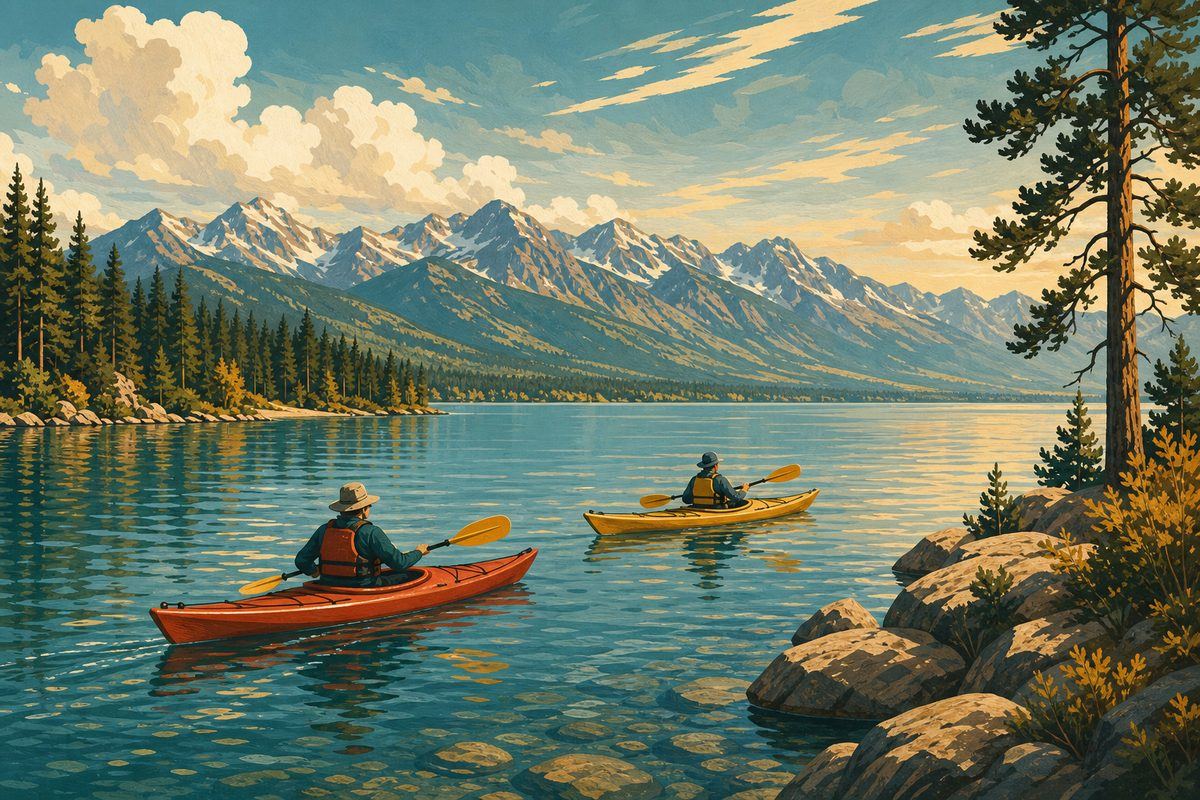
The most commonly used crossing runs from the Big Arm area, on the lake’s west shore. It’s the shortest realistic route to the island from the mainland, commonly described as covering something in the neighborhood of two miles of open water, and by motorboat it’s typically a crossing of well under an hour. For paddlers in a kayak or canoe, that same distance is a real open-water undertaking rather than a quick hop — there’s no shoreline to duck into partway across, and conditions on open water can shift faster than they look like they will from shore. Longer crossings are possible from other points around the lake, including from the Dayton area on the east side, but they take considerably more time and are a bigger commitment for a paddle-powered trip.
Flathead Lake has a well-earned reputation for building wind through the day, especially on its more open stretches, and the water around Wild Horse Island is no exception. Mornings tend to be the calmest window; conditions can deteriorate by early afternoon, sometimes quickly enough to catch a boater off guard. Anyone making the crossing — whether by motorboat, sailboat, or paddle craft — is better off checking an actual wind forecast rather than just looking at the water from the launch point, and building in enough of a time margin to be back across before conditions typically worsen.
There’s no single official dock or landing on the island for public use. Instead, boaters typically come ashore at one of several recognized public landing points scattered around the island’s perimeter — named spots like Skeeko Bay, Eagle Cove, Rocky Bar, Driftwood Point, Osprey Cove, and East Shores turn up repeatedly in local guidance as the accepted places to anchor offshore or beach a small craft directly on the shoreline, rather than tying up at any structure, because there isn’t one to use. Private docks do exist on parts of the island, tied to the private land parcels described below, and those are off-limits to the general public; sticking to one of the recognized public landing areas keeps you clear of private property without needing to know exactly where every boundary line runs.
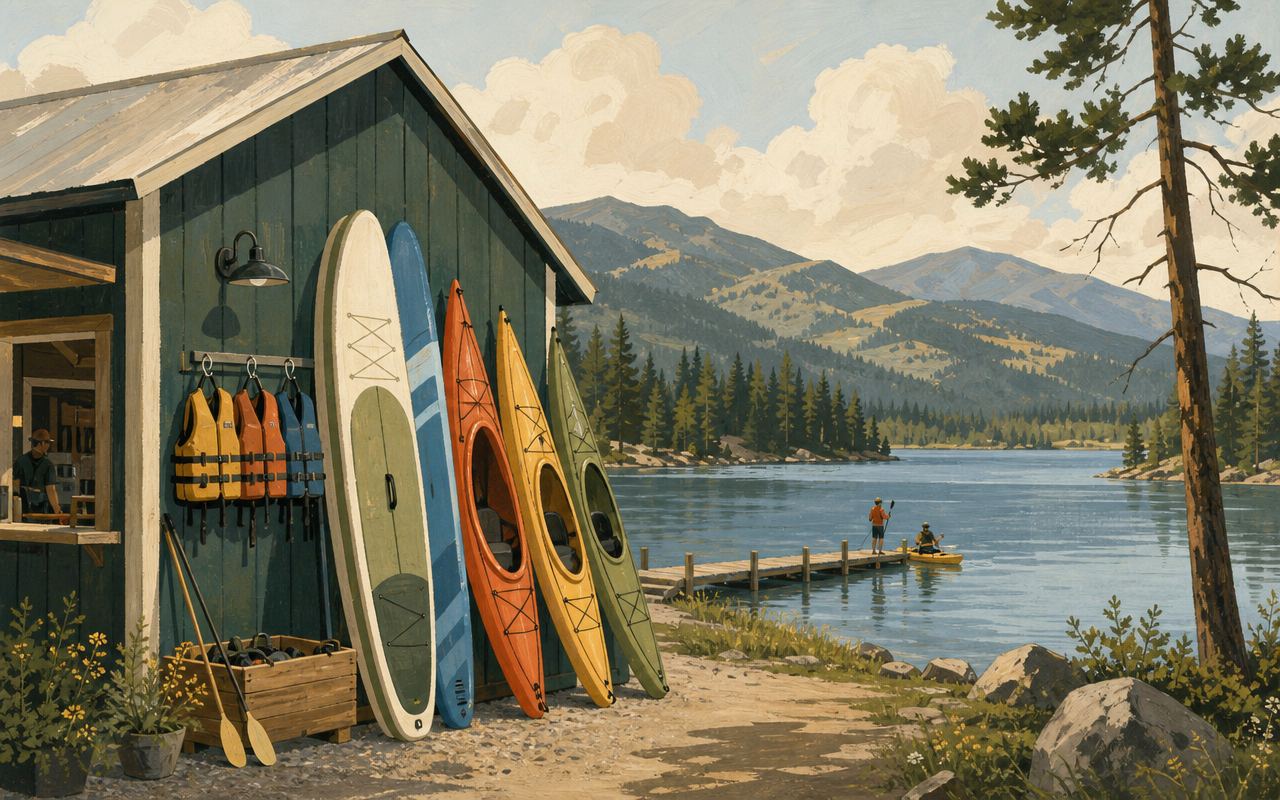
For anyone without their own boat, the practical options are a rental — a motorboat, pontoon, kayak, or paddleboard from one of the marinas around the lake — or a seat on a guided tour, several of which run out to the island in season and handle the crossing and, often, some narration about what you’re looking at once you land. Either route works; the choice mostly comes down to how much you want to manage your own timing and route versus letting someone else worry about the crossing.
Once you’re ashore, there’s nothing waiting for you in the way of services. No restrooms, no potable water source, no trash cans, no covered shelter if weather turns. Whatever you plan to eat, drink, or need over the course of the visit has to come with you, and everything you bring in — including all trash — needs to leave with you as well. That’s a normal expectation for a primitive, undeveloped island, but it’s worth planning around explicitly rather than assuming any amenities exist.
From the landing areas, a modest network of trails — several miles total — climbs up from the shoreline into the island’s open grassland and forested hillsides. The trails aren’t heavily engineered or, in places, clearly marked, and they can be steep and exposed to sun and wind once you’re up out of the trees. Good footwear and a general sense of the route back down matter more here than on a maintained mainland trailhead with signage at every junction.
Wildlife
The wildlife is the reason most people make the crossing in the first place, and the island earns its reputation. Bighorn sheep are the animal most associated with the place — a population that was deliberately established here decades ago and has grown substantially over the years since, taking advantage of the island’s isolation from predators and hunting pressure to reach numbers well beyond what a similarly sized piece of mainland habitat would typically support. Sightings are common on the open hillsides, sometimes at surprisingly close range, since the sheep here have had little reason to develop the wariness of humans that a mainland herd would.
Mule deer share the island with the sheep, and they’re similarly used to the absence of predators — visitors and longtime observers alike have noted that the deer here tend to look larger and healthier than mule deer typically do on the mainland, likely a reflection of good forage and low predation pressure rather than a different subspecies. Between the two, hoofed wildlife is close to a guaranteed sighting for anyone spending a few hours exploring the trails.
Birdlife is the other major draw. Bald eagles nest and hunt around the island’s shoreline, taking advantage of the lake’s fish population and the undisturbed trees on the higher ground. Ospreys, various hawks and falcons, and a wide range of waterfowl and songbirds round out a bird population that’s genuinely rich for the island’s size — a reasonable amount of research and casual observation over the years has documented well over a hundred species of birds and mammals combined using the island at some point.
Then there are the wild horses the island is named for: a small band, commonly reported at around five animals, descended from — or at least continuing — a tradition of horses living semi-wild on the island that stretches back well over a century. They’re a modest presence numerically compared to the sheep and deer populations, and they roam freely rather than sticking to any predictable spot, so seeing them on a given visit is a real possibility rather than a guarantee. Feral horse numbers can shift over time with births, deaths, and occasional management intervention, so no fixed count should be treated as current — treat any specific figure, including the one commonly cited here, as an approximation rather than a census.
None of the island’s animals are tame, whatever their apparent comfort with human visitors at a distance. Bighorn rams, in particular, are large, strong animals capable of serious injury if provoked or cornered, and horses — wild or not — can behave unpredictably around people who get too close. The standard, sensible approach applies here as much as anywhere: view from a respectful distance, never approach or attempt to feed any animal on the island, and treat every sighting as an observation opportunity rather than a photo-op to be engineered by getting closer.
A pair of binoculars or a camera with reasonable zoom does more for a Wild Horse Island visit than almost any other single item in a daypack. Much of the wildlife here is visible from open hillsides and ridgelines at a distance rather than up close along the shoreline trails, and the island’s relative lack of tree cover on its upper slopes — a legacy of both natural grassland and the grazing pressure of its resident herds — actually works in a visitor’s favor for spotting animals across a wide field of view.
Rules
Wild Horse Island’s rules exist almost entirely to protect the wildlife and habitat that make it worth visiting, and they’re stricter in some ways than a typical state park because the island is small, self-contained, and home to animals with nowhere to retreat if disturbance becomes constant.
It is day-use only. There’s no overnight camping permitted anywhere on the island, and no designated campsites to use even informally — visitors are expected to arrive, spend the day, and leave before dark. Pets are not allowed, a rule specifically aimed at preventing dogs from chasing or stressing the sheep, deer, and horses that live here full-time; even a calm, leashed dog represents a kind of disturbance the island’s wildlife doesn’t otherwise face. Bikes are similarly prohibited, for much the same reason — fast-moving wheeled traffic on a small island’s trail network is a bigger disruption to grazing animals than foot traffic. Open fires and smoking are banned across the entire island, both because the grassland and forest here can be genuinely fire-prone in dry conditions and because smoke and open flame are their own form of disturbance.
Not all of the island is public land. Alongside the state park acreage, there are privately owned parcels on Wild Horse Island, a fact that surprises some first-time visitors expecting the whole island to be park property. Visitors should stay off private land, avoid using private docks, and keep to the public trail network and recognized public landing areas rather than assuming they can walk or land anywhere the terrain allows.
One rule that catches boaters and anglers off guard: the waters around the southern part of Flathead Lake, including those around Wild Horse Island, lie within the Flathead Indian Reservation. Anyone fishing in that area needs a joint state and tribal fishing license rather than relying on a standard Montana fishing license alone — worth sorting out before you go rather than discovering the requirement on the water.
Beyond the specific rules, the island runs on a broader ethic of low-impact visiting: pack out everything you bring in, stay on established trails where they exist rather than cutting new paths across open grassland, and treat the absence of any staff or ranger presence as a reason for more self-discipline, not less.
Group size and noise are worth thinking about even though neither is spelled out as a formal limit. A quiet pair of hikers moving slowly along a trail disturbs wildlife far less than a large, loud group covering the same ground, and on an island this size that difference is more noticeable to the animals living there than it would be in a bigger, more heavily used park. Since the whole appeal of the island rests on the wildlife behaving naturally rather than fleeing every time a boat lands, visiting in a way that keeps disturbance low is less a rule than simple self-interest for anyone hoping for a good sighting.
History
The name “Wild Horse Island” isn’t a marketing invention layered onto an otherwise unremarkable island — it reflects a documented historical practice. For generations, the Salish and Kootenai people used the island as a place to pasture horses, taking advantage of the surrounding water as a natural barrier. Horses could be moved out to the island and largely left there, safer from the raiding and horse theft that were a real and recurring risk on the mainland during periods of conflict with other groups, including the Blackfeet. Herds were reportedly moved across by swimming them out during warmer months and, in some accounts, led across the ice once the lake froze in winter.
The island was part of the Flathead Indian Reservation, established in 1872, until the early twentieth century, when it — like much of the reservation — was allotted into individual parcels of land, a process that eventually led to some of that land passing into private and later state ownership. That allotment history is part of why the island today is a mix of state park land and privately held parcels rather than a single uninterrupted block of public property.
For much of the twentieth century, a large share of the island was held by a single private owner rather than open to the public at all. It wasn’t until the late 1970s that Montana, working with the Nature Conservancy and federal land-conservation funding, was able to acquire the bulk of the island for public use as a state park — reportedly at a price well below its appraised value, a detail conservation histories of the island tend to point to as evidence of how much the seller and the state both wanted it kept largely intact rather than subdivided further. Some individual parcels stayed in private hands through that transition, which is the direct source of the private inholdings visitors still encounter on the island today.
The small band of horses living on the island today carries that older history forward in a direct, visible way, even though today’s animals are feral rather than actively managed livestock. It’s a genuinely documented piece of regional history rather than a romanticized legend attached after the fact, and it’s worth treating with the same factual respect on a visit as any other piece of the area’s Indigenous history — a real practice, tied to a real and continuing threat of raiding, rather than a folk tale dressed up for tourists.
When to go
The most practical window for visiting Wild Horse Island runs from late spring through early fall, roughly May into October, when both the lake crossing and the island itself are at their most comfortable and accessible. Outside that window, boat access becomes far less reliable and, depending on conditions, the crossing itself can become genuinely risky rather than simply less pleasant.
Late spring brings its own particular rewards: wildflowers across the island’s open grassland, and the chance of seeing young animals — lambs among the bighorn sheep especially — not long after they’re born. Water and air temperatures are cooler at this end of the season, which matters more for anyone paddling across than for those arriving by motorboat.
Midsummer offers the most reliable weather window and the warmest water, which is part of why it’s also the busiest stretch of the season on the lake generally — more boat traffic around popular launch points and a higher chance of encountering other visitors on the island’s trails. Early fall can offer a quieter version of the same good conditions, with cooling temperatures but often still-manageable water and weather, before the crossing becomes a colder, more marginal undertaking as the season turns.
Whatever the month, mornings are consistently the better time both for the crossing itself — before wind has a chance to build — and for wildlife viewing, since animals on the island, like most wildlife, tend to be more active in the cooler hours around sunrise and, to a lesser extent, sunset. A midday visit isn’t wasted, but a visitor who can time a landing for the morning and plan to be back across the water before afternoon wind typically arrives gets the better version of what the island has to offer, on both counts.
Wild Horse Island State Park Guide, Montana: Quick Facts
A short summary for this Wild Horse Island state park guide: the island sits inside Flathead Lake in Montana, it’s boat-access only, and it has no facilities of any kind. Anyone researching Wild Horse Island State Park before a trip should know the crossing point (Big Arm), the rules (day-use only, no pets, no bikes), and the wildlife (bighorn sheep, mule deer, a small band of horses). This Montana state park guide exists specifically because Wild Horse Island Flathead Lake trips get planned wrong more often than any other stretch of water covered here — people assume they can camp, or bring a dog, or land anywhere they like, and none of that is true. Treat this Wild Horse Island State Park guide as the pre-trip checklist, and treat the island itself as public land shared with genuinely wild animals that have nowhere else to go. Anyone who searched wild horse island flathead lake directly and landed on this page is in the right place — everything above covers exactly that crossing and that island.
Frequently asked questions
Can you camp overnight on Wild Horse Island?
No. The island is managed as a day-use site only, with no overnight camping permitted anywhere on it. Visitors are expected to land, explore, and leave the same day, and there are no designated campsites or overnight facilities to use even informally.
Can I bring my dog?
No, pets are not allowed on the island. The rule exists specifically to protect the resident wildlife — bighorn sheep, mule deer, and the island's small band of horses — from being chased, stressed, or displaced by dogs, even well-behaved ones on a leash.
How do I get to Wild Horse Island if I don't have my own boat?
You'll need to arrange transportation, since there's no bridge, ferry, or scheduled public boat service. Local marinas, boat rental operations, and guided tour outfits around Flathead Lake offer trips to the island in season, or you can go by private boat, canoe, or kayak if you have the right craft and experience for open water. This guide doesn't recommend a specific outfitter — ask around at lake-area marinas for current options.
Is there a fee to visit the island?
Yes, a day-use fee applies, consistent with other Montana state park sites. Check current Montana Fish, Wildlife & Parks guidance before your trip for exact requirements, since fee structures and any pass options can change from year to year.
What wildlife will I actually see?
Bighorn sheep and mule deer are the animals most visitors reliably spot, often at some distance on open hillsides. Bald eagles, ospreys, and a range of waterfowl and songbirds are also commonly seen, and the island is home to a small band of wild horses — though the horses roam freely and aren't guaranteed to be visible from any given trail on any given day.
How many wild horses actually live there?
Reports commonly put the band at around five horses, though feral horse populations can shift over time and no source promises a fixed, current count. The animals are the island's namesake, but they're a small supplementary presence — the bighorn sheep and mule deer populations are considerably larger.
Is it safe to swim near the island?
Swim with caution. Flathead Lake is deep, cold even in summer, and can turn choppy quickly if wind picks up, and the island's shoreline has no lifeguards or rescue services. Sheltered coves in calm conditions are more forgiving than open shoreline, but treat any swim here the way you would open, cold water anywhere else on the lake.
Can I ride a mountain bike on the island's trails?
No, bikes aren't permitted. Like the ban on pets, this is meant to reduce disturbance to grazing wildlife on a fairly small, contained island where animals have limited room to retreat from fast-moving traffic on the trails.
Are there restrooms, water, or other facilities on the island?
No. Wild Horse Island has no visitor facilities — no restrooms, no potable water, no trash service, no shade shelters. Plan to bring everything you'll need for the day and pack out everything you bring in, including all trash.
Can I fish in the waters around Wild Horse Island?
You can, but check your license first. The southern portion of Flathead Lake, which includes the waters around the island, lies within the Flathead Indian Reservation, and anglers there need a joint state and tribal fishing license rather than a standard Montana license alone.
Is the entire island public park land?
No. While most of Wild Horse Island is managed as state park land, there are also privately owned parcels on the island. Visitors should stay off private property, avoid private docks, and keep to the public trail network and designated public landing areas.
Why is it called Wild Horse Island?
The name comes from a documented historical practice: the Salish and Kootenai people used the island to pasture horses, taking advantage of the water crossing to keep herds safer from raids by rival groups. A small band of horses has continued to live on the island in the time since, which is where the modern name comes from.
How long does the boat crossing take?
From the Big Arm area on the mainland, the shortest crossing is commonly covered in well under an hour by motorboat, and is often cited as roughly two miles of open water for paddlers. Crossings from farther launch points, such as Dayton on the lake's east side, take substantially longer and are a more demanding undertaking.
What's the best time of year to visit?
Late spring through early fall — roughly May into October — is when weather, water conditions, and wildlife activity line up best for a visit. Spring brings wildflowers and young animals; mornings and evenings, in any season, tend to be the more active times for spotting wildlife on the hillsides.
Are there hiking trails on the island?
Yes, the island has a modest network of trails, several miles in total, that climb from the shoreline landing areas up into open grassland and forested hillside. Trails are unmarked in places and can be steep and exposed, so sturdy footwear and some route awareness are worth having.
Do the bighorn sheep or wild horses ever approach visitors?
They can, since the island's animals have had little exposure to predators and are sometimes visible at fairly close range. That doesn't make them tame — they're wild animals on their own turf, and visitors should keep a respectful distance and never attempt to approach, feed, or touch them.
Can I have a campfire or barbecue while I'm there?
No. Open fires and smoking are prohibited across the island, both to protect the dry grassland habitat from fire risk and to avoid disturbing wildlife. Bring food that doesn't require cooking on-site, or plan around this restriction before you land.
What should I pack for a day trip to the island?
Water, sun protection, sturdy footwear for uneven trail terrain, and a life jacket for the boat crossing are the essentials, since there's nothing to buy or refill once you're ashore. A camera or binoculars are worth the extra weight, since wildlife viewing is the main reason most people make the trip.