Most of what people picture when they imagine a Montana lake in January — a flat white sheet of ice thick enough to drive a truck across — doesn’t actually describe Flathead Lake most winters. This is the largest natural freshwater lake west of the Mississippi, a long, deep basin with enough open water and exposed fetch that it behaves more like a small inland sea in cold weather than a pond. The result is a winter season that’s real, distinct, and worth understanding on its own terms, but one that rarely matches the postcard image of a fully frozen lake.
This guide goes deeper than a quick seasonal overview. It covers what actually happens to the ice, where that ice becomes something you can fish from, what stays open and what shuts down for the season, and what a winter visit to the lake and its shoreline towns is genuinely like.
Does the lake actually freeze?
Flathead Lake’s winter behavior comes down to volume and wind exposure. The lake holds an enormous amount of water relative to its surface area, and that water doesn’t cool or freeze uniformly the way a small, shallow pond does. For the open central and southern basin to freeze over completely, the region needs an extended stretch of genuinely severe cold — commonly cited as roughly ten or more consecutive days at minus 10°F or colder — paired with calm air, since even modest wind is enough to keep newly forming ice broken up across that much open water. Those two conditions rarely show up together for that long. A complete, lake-wide freeze is a documented rarity: the most recent full freeze most sources point to is 1989, and a partial freeze was reported again in 2019, but neither is close to an annual event.
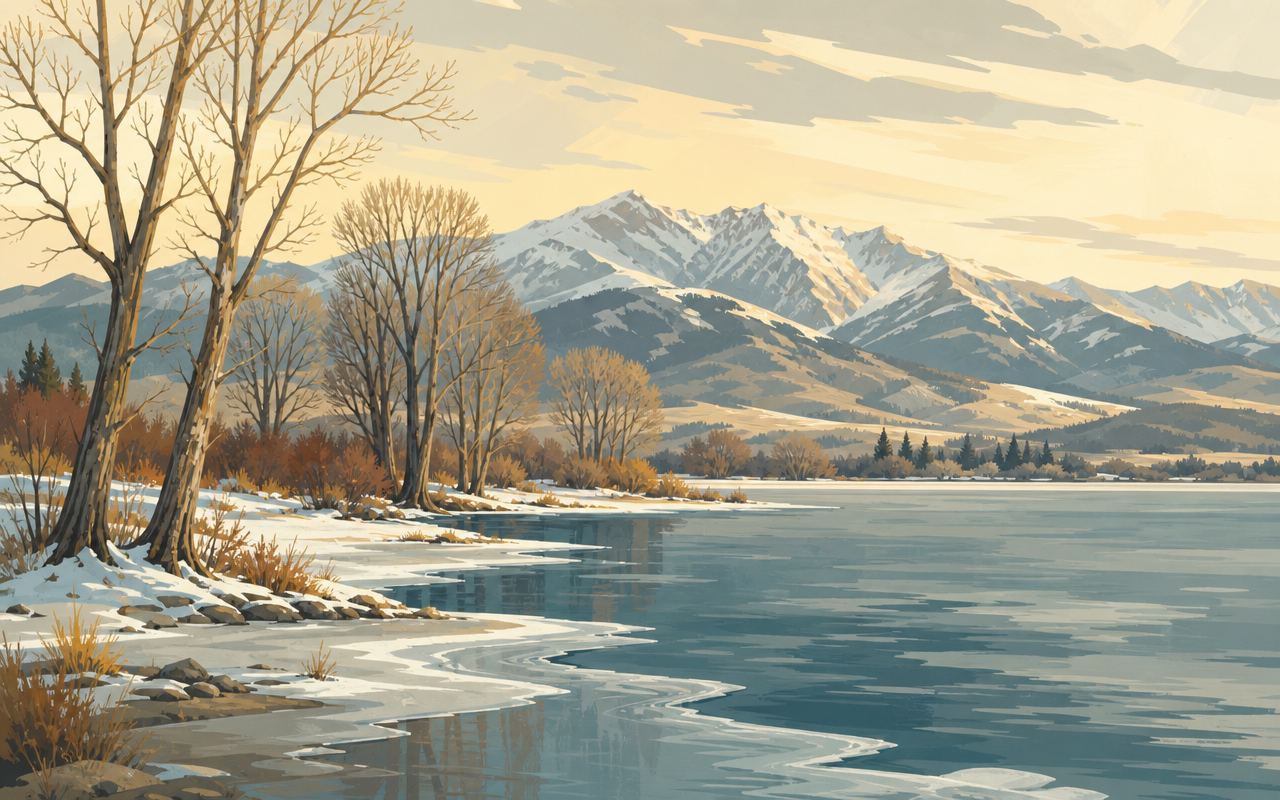
What happens far more often is a partial, patchwork freeze. Shallow, wind-sheltered bays cool and ice over on a fairly normal schedule, while the long, deep, wind-exposed main basin stays liquid, sometimes visibly giving off steam on the coldest, calmest mornings as relatively warmer lake water meets much colder air above it. That contrast — solid ice in a quiet cove a few hundred yards from open, moving water — is the lake’s actual, typical winter character, and it’s worth expecting rather than being surprised by if you visit between December and March.
Ice fishing on Flathead Lake
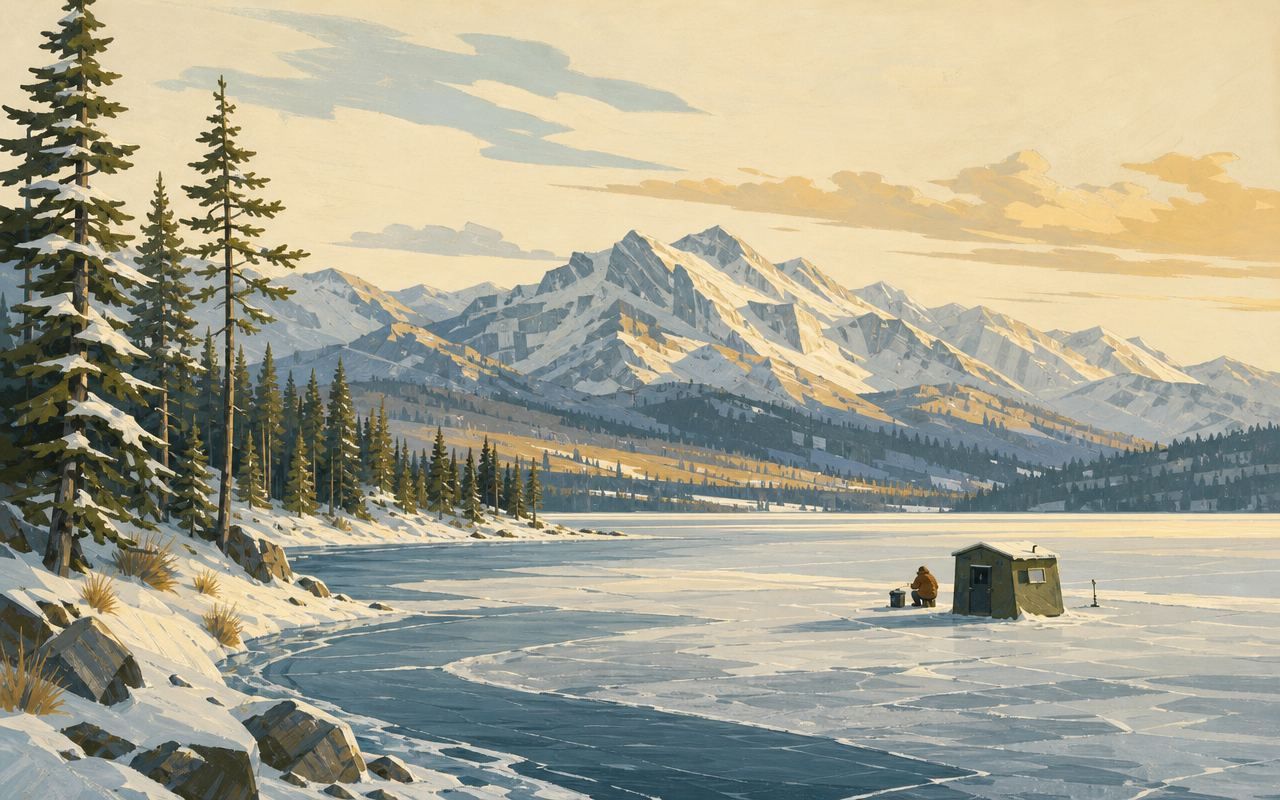
The bays that reliably ice over are also where the lake’s ice fishing season happens. Somers Bay at the north end and Polson Bay at the south end are the two most consistently mentioned by anglers and outfitters, and several other sheltered spots come up regularly as well: Big Arm Bay, Elmo Bay, Skidoo Bay, and the calmer water around Melita Island, among others. These areas share the same basic trait — enough shelter from wind and enough shallow water to freeze on something closer to a normal lake’s schedule, even in a winter when the main basin never comes close.
Lake whitefish and lake trout (locally called mackinaw) are the two species most associated with the ice season, with yellow perch also turning up in some of the bays. Whitefish and perch in particular tend to carry liberal bag limits, and both Montana Fish, Wildlife & Parks and the Confederated Salish and Kootenai Tribes (CSKT), which co-manage different portions of the lake, have encouraged anglers to harvest them.
That co-management points to a genuinely useful, non-obvious planning detail: Flathead Lake is split between two licensing jurisdictions. The northern part of the lake falls under Montana FWP rules and a standard state fishing license. The southern part, roughly from the Polson area south, sits within the Flathead Indian Reservation and requires a separate CSKT tribal fishing permit in addition to (not instead of) a state license. Anyone planning to ice fish the southern bays should have both sorted out before heading out, since the two systems aren’t automatically bundled together.
On safety, this guide is going to stay deliberately general, and that’s on purpose. Ice thickness on Flathead Lake varies by bay, by winter, and by week within the same winter, and even experienced local anglers describe reading conditions bay by bay rather than trusting a single blanket rule for the whole lake. Montana FWP does publish ice-safety guidance each winter, but it’s framed as general advice for any Montana ice — checking for clear versus cloudy or gray ice, staying away from inlets and structure where moving water can thin ice from underneath, never fishing alone, and treating no ice as guaranteed safe regardless of how thick it looks. Rather than repeat a specific thickness number here as if it applied uniformly to every bay on Flathead Lake at every point in a given winter, the honest guidance is to check current, local conditions before walking onto any ice — a recent fishing report, a call to a regional FWP office, or word from someone who was just out there will tell you far more than any general figure.
What’s open, and what’s closed, for winter
Winter thins out the infrastructure built around the lake’s warm-season paddling and boating traffic. Several Flathead Lake State Park units close their boat launches for the season, with Big Arm typically available only from mid-March through November before shutting down for winter. A smaller number of deep-water launches, including West Shore and Yellow Bay, are generally kept usable through the winter months, though exact status can shift with lake level, ice, and weather in a given year.
Regional access follows a similar pattern. Glacier National Park’s Going-to-the-Sun Road — a common add-on for visitors already in the valley — has its high alpine section close for the season around mid-to-late October, well before the depths of winter, and it doesn’t reopen until crews clear it the following spring. The lower stretch from West Glacier to Lake McDonald Lodge is typically plowed and kept open year-round, so a winter visitor can still reach that part of the park, just not cross the mountains on the road’s famous high section. None of this is specific to the lake itself, but it’s worth knowing if a winter trip to Flathead Lake is being paired with a Glacier stop, since the two are often planned together and the road’s status changes the shape of that combined trip considerably.
Paddling and rafting, the activities most of this site is built around, are effectively off the table on the lake and its feeder rivers during the winter months, both because of cold water and because most of the supporting services — rental shops, guided trips, many launches — are seasonal and closed.
Winter recreation beyond the ice
Ice fishing isn’t the only documented winter activity tied to the lake area, though most of what else is available sits just off the shoreline rather than on the water itself. The Blacktail Mountain Nordic Trails, located above the town of Lakeside on the lake’s west shore, offer a groomed cross-country ski network with views down over the lake basin, maintained by the North Shore Nordic Club. On the opposite side of the valley, the Bigfork Community Nordic Center provides a similar groomed trail system for the lower Flathead Valley’s east side. Neither is on the lake itself, but both sit close enough to it, and are oriented enough around its basin, that they function as a genuine winter counterpart to the summer paddling season this site otherwise covers.
Beyond organized Nordic skiing, winter recreation around the lake is mostly the ice fishing already covered plus general sightseeing — shoreline drives and quiet stops in towns like Polson, Somers, and Bigfork, all of which stay open through winter even as tourist-season infrastructure scales back.
The general character of a winter visit
A winter trip to Flathead Lake is a genuinely different experience from a summer one, worth planning for on its own terms rather than as a colder version of the same visit. Traffic and crowds drop off sharply once the boating season ends, and towns around the shoreline settle into a slower, local rhythm. Days are short, and valley weather can shift quickly, with cold snaps, snow, and stretches of gray, overcast sky all part of a typical season. The open stretches of lake often take on a strikingly different look in winter light — flat and steel-gray under cloud, or catching low sun across open water framed by snow-covered shoreline and, on a clear day, the surrounding mountains.
None of that lends itself to a packed, activity-driven itinerary. A winter visit built around the lake tends to work best framed as a quieter trip: a chance to see the shoreline and surrounding valley from an angle most visitors never encounter, with ice fishing in the right bay, a day of Nordic skiing nearby, and unhurried stops in lake towns filling out the rest of the time, rather than the paddling, swimming, and rafting that define the other three seasons here.
Planning around a winter visit
The throughline across all of this is that Flathead Lake’s winter doesn’t behave like a single, predictable season — it behaves like a set of local conditions that shift bay by bay and year by year. The lake as a whole rarely freezes solid, but specific bays reliably do. Some boat launches close for the season while others stay open. Regional attractions like Going-to-the-Sun Road scale back to a fraction of their summer route. None of that makes winter a bad time to visit, but it does mean the useful planning question isn’t “is the lake frozen” so much as “what’s actually open and safe right now, in the specific spot I’m headed to” — a question best answered with a current local check rather than a general guide, this one included.
Frequently asked questions
Does Flathead Lake freeze solid in winter?
Almost never, and not predictably. The lake is large, deep, and open to wind, so a complete freeze needs an extended run of very cold, very calm air — roughly ten or more consecutive days at minus 10°F or colder with little to no wind. That alignment is uncommon; the most recent full freeze on record is generally cited as 1989, with a partial freeze reported again in 2019. Most winters, the open central and southern basin stays as liquid water while sheltered bays ice over.
Which bays on Flathead Lake reliably ice over?
Somers Bay and Polson Bay at the lake's north and south ends are the two most consistently cited, along with Big Arm Bay, Elmo Bay, and smaller pockets like Skidoo Bay and the water around Melita Island. These are shallower, more sheltered areas that lose heat and calm down faster than the long open fetch of the main basin, so they can carry usable ice even in a winter when the lake as a whole never comes close to freezing.
Is it safe to walk out on Flathead Lake ice?
Don't treat any lake ice as automatically safe, on Flathead Lake or anywhere else. Ice thickness varies by bay, by year, and even by week within the same winter, and it can be honeycombed or thin in spots that look solid from shore. Montana Fish, Wildlife & Parks publishes general ice-safety guidance every winter, and the standard recommendation is to confirm current, on-the-ground conditions — through a local fishing report, an FWP office, or someone who was just out there — before walking onto ice anywhere on the lake.
Do I need a special permit to ice fish on Flathead Lake?
Possibly, depending on where. Flathead Lake is split between two fishing jurisdictions: a Montana FWP license covers the northern portion, while the southern portion, roughly from the Polson area south, sits within the Flathead Indian Reservation and requires a Confederated Salish and Kootenai Tribes (CSKT) fishing permit, sold separately from the state license. Anyone planning to fish the southern half of the lake should have both in hand before heading out.
What fish can you catch ice fishing on Flathead Lake?
Lake whitefish and lake trout (also called mackinaw) are the two fish most associated with Flathead Lake's ice season, with yellow perch also present in some bays. Whitefish and perch generally carry liberal bag limits, and management agencies have actively encouraged harvesting both.
Are boat launches open on Flathead Lake in winter?
Not all of them. Several Flathead Lake State Park units, including Big Arm, are typically available only from mid-March through November and are closed in winter. A handful of deep-water launches, including West Shore and Yellow Bay, are generally kept usable year-round. Status can vary with lake level and weather, so it's worth confirming before a winter trip.
Is Going-to-the-Sun Road open in winter?
No, not the full route. The alpine section of Glacier National Park's Going-to-the-Sun Road typically closes for the season around mid-to-late October and doesn't reopen until late spring, well after the snow has been cleared. The lower stretch between West Glacier and Lake McDonald generally stays plowed and open year-round, weather permitting, but the high-country crossing that most visitors picture is a summer-and-fall-only drive.
Is there anything to do around Flathead Lake in winter besides ice fishing?
Yes, mostly just off the shoreline rather than on the water. Nordic skiing is a genuine regional draw, with the Blacktail Mountain Nordic Trails above Lakeside offering groomed cross-country terrain with views down onto the lake, and the Bigfork Community Nordic Center covering the lower valley's east side. Both are maintained by the North Shore Nordic Club. Beyond that, winter around the lake is largely about quiet shoreline drives, valley scenery, and towns running at a slower, off-season pace.